Military Ancestor Research: Your Family's Service Record, Fully Investigated
Someone in your family served. I find out who they were, what they did, and what happened to them.
Professional military ancestor research for the UK and Ireland, done entirely for you by Gary Skerritt. Based in Nottingham. Available nationwide.
Most families have a soldier in them somewhere. Most have never found the full story.
You know they served. You might have a photograph in uniform, a medal in a box, a name on a local war memorial, or just a fragment of a story passed down the family and never properly checked. You have always felt that someone in the family should do something with it.
The problem is knowing where to start. Military records are scattered across multiple archives, approximately 60% of WW1 service records were destroyed in the fires of 1940, and the system of service numbers, regiments and battalions is bewildering if you are coming to it fresh. It is easy to search and find nothing. It is even easier to find the wrong person.
- You found a medal, a photograph, or a regimental badge and you do not know the story behind it.
- You tried searching WW1 or WW2 records online and found nothing, or found too many people with the same name.
- You know your ancestor served but you do not know where, when, or whether they came home.
- You want to find out if your ancestor was decorated, and what exactly they did to earn it.
- You would like to visit the places where they served, but you need to know exactly where that was.
- An elderly relative remembers the stories, and you want them properly researched before the last living memory fades.
Military ancestor research, done entirely for you.
I do not just search the obvious databases. I work through every record set relevant to your ancestor's service: WW1 and WW2 military records, medal cards, pension files, regimental histories, unit war diaries, and the specialist collections at The National Archives, the Imperial War Museum and regimental museums. Where records were damaged or destroyed, I use alternative sources to piece the story back together.
The records I work through
- WW1 Service Records. Approximately 60% were destroyed in the Blitz in 1940. I know how to extract information from the surviving burnt documents and fragmentary records.
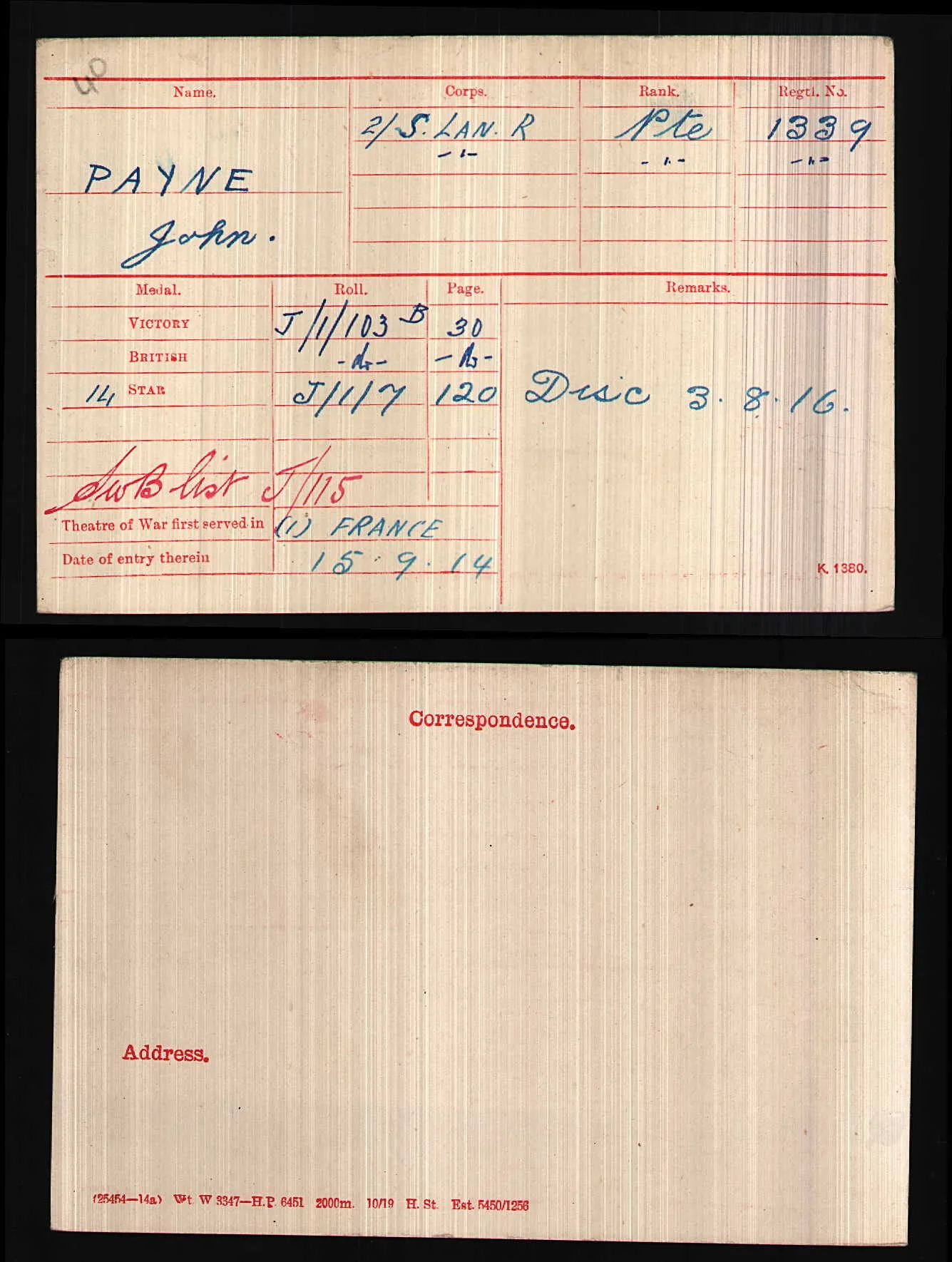
- Medal Cards and Medal Rolls. The WW1 medal index cards survive almost entirely and are a foundational record. Medal rolls provide unit and service number detail.
- Pension Records. WW1 pension ledgers and Ministry of Pensions files often survive where service records do not, and contain physical descriptions, injury records, and personal detail.
- WW2 Service Records. Held by the Ministry of Defence, released to next of kin on application. I manage the formal request and follow-up on your behalf.
- Unit War Diaries. Kept by every unit, recording daily movements, actions, casualties and significant events. They place your ancestor in specific locations and battles.
- Earlier Conflicts. Boer War, Crimea, India, the Napoleonic period. I work across all periods, using regimental histories, muster rolls and the specialist military collections at Kew.
For a full overview of available UK military records, see the military records guide.
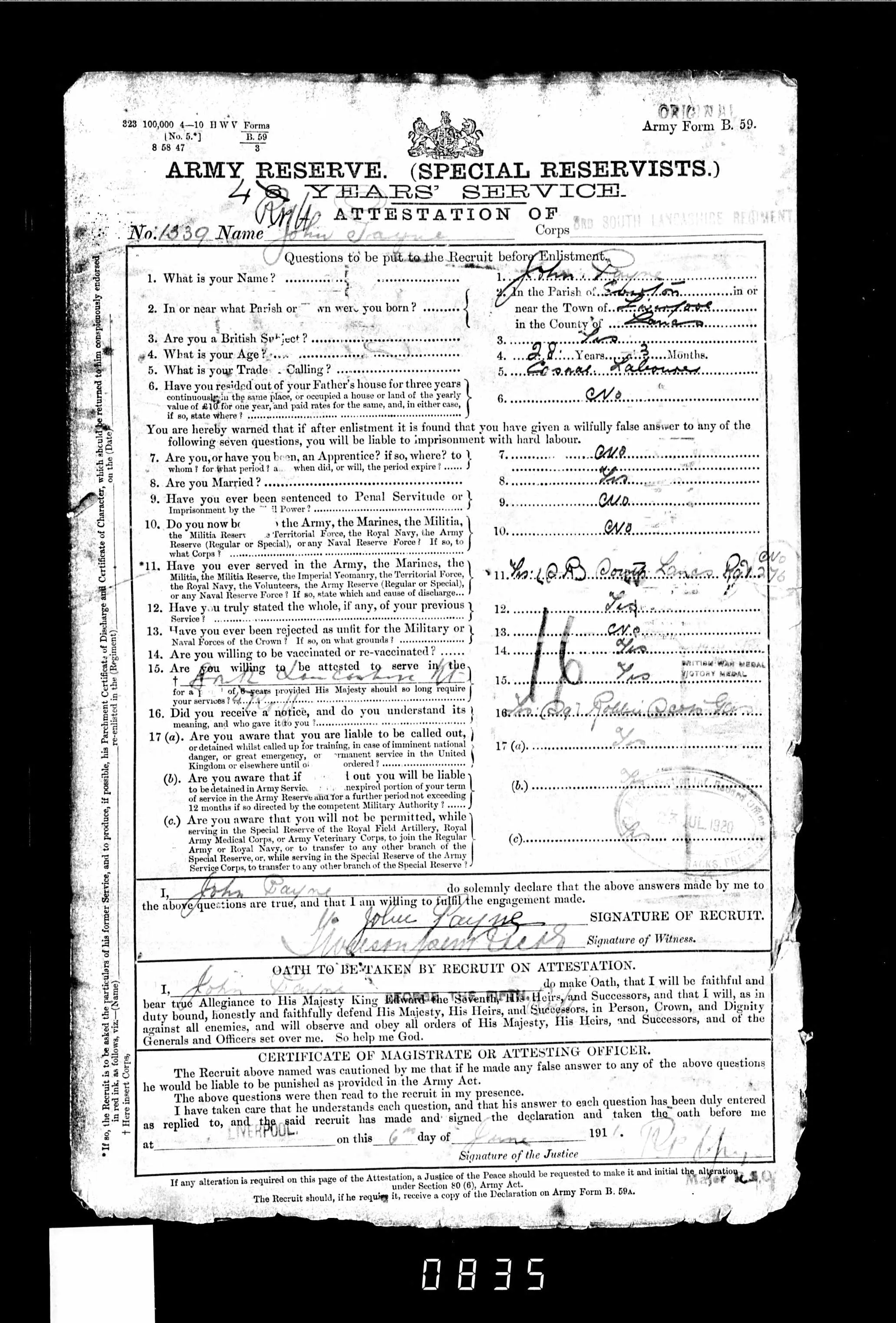
Army Reserve attestation form, Army Form B.59. Signed on enlistment, recording the soldier's name, age, trade, prior service, and oath of allegiance.
Every investigation is different. Some ancestors left a rich trail of records. Others are harder to find. Whatever the case, I work through every available source before drawing conclusions and I tell you honestly what the evidence shows.
Gary Skerritt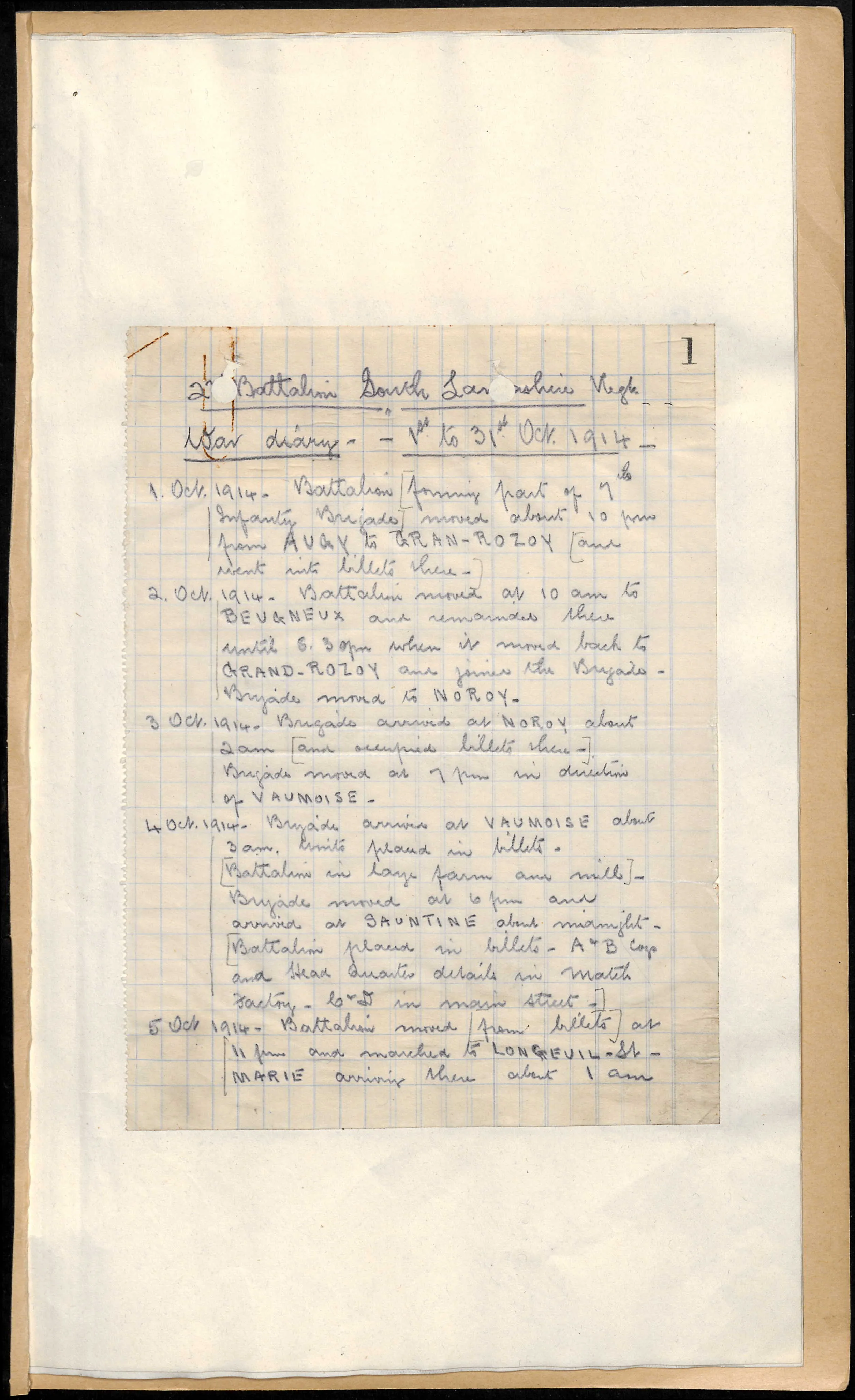
War Diary of the 2nd Battalion South Lancashire Regiment, October 1914.
A complete Military Heritage Report.
Fixed pricing. No hourly rates. No surprise invoices.
You will know the full cost before I begin. Every investigation is different, but the price never is.
One ancestor. One complete service story.
- Full investigation of one military ancestor
- All relevant records consulted
- Written Heritage Report
- Original record scans
- Service timeline
- Full source citations
- Follow-up call included
Full service history, plus family context.
- Everything in Single Ancestor
- Military and civilian family history combined
- Full family context: who they left behind, who greeted them
- Expanded Heritage Report with family narrative
- Family tree diagram, two to three generations
- Original document scans throughout
- Follow-up call included
A complete military heritage book to keep.
- Everything in The Full Service
- Beautifully produced Heritage Book, hardcover
- Printed document facsimiles included
- Named ancestor dedication page
- Ideal as a family heirloom or memorial gift
- Suitable for framing key documents or photographs
Not sure which is right for your ancestor? Book a free 30-minute call and I will recommend the right option based on what you know and the records most likely to survive.
Military research makes a powerful gift, particularly for elderly relatives who remember the stories but have never had them properly investigated. The Legacy Edition is especially meaningful as a tribute or a memorial. See the gifts page for gift voucher options.
You do not need to know anything about military records to start.
Most investigations begin with very little: a name, a rough date of birth, a regiment if you are lucky. That is enough. Here is what happens next.
The Free Call
We talk for 30 minutes. You tell me what you know, however little, and I explain exactly what I can likely find, which records to target, and what a realistic outcome looks like.
The Investigation Brief
I send a written confirmation of exactly what I will investigate and what it will cost. You approve it. Nothing starts until you are completely happy.
The Research
I investigate. You wait. I contact you when something significant is found and at agreed milestones. No surprises, no silence.
The Heritage Report
You receive your complete report, your ancestor's service story in full. Then we talk through every discovery together on a follow-up call.
No obligation. No preparation needed. Just bring what you know.
Twenty years of investigation. One investigator. Your ancestor's story.
My name is Gary Skerritt. I am a family history investigator based in Nottingham, and I have been researching UK and Irish family histories for twenty years. I do not farm this out. I do not use assistants. When you commission an investigation from me, I do every piece of the research myself.
Military records are a substantial part of that work. Most UK families have at least one ancestor who served in the conflicts of the twentieth century, and many have military connections stretching back much further. I have worked with WW1 burnt documents, WW2 Ministry of Defence records, regimental histories from the Boer War and the Crimea, and pension and medal records from across the nineteenth and twentieth centuries.
I approach every military investigation the way I approach all family history research: as a proper investigation rather than a database search. When the obvious records are missing, I look for the less obvious ones. When a name is common, I triangulate through other sources. When records are damaged or incomplete, I work around them.
I also understand that military research often carries emotional weight. For many families, discovering the full truth of how a relative served, or how they died, is a deeply meaningful thing. I handle every investigation with the care that deserves.
You can see exactly how I investigate in the William Goddard case study: a complete investigation from question to conclusion, tracing my own family's convict ancestor through the Victorian record system. The methodology is the same for every investigation, including military ones.
Read the William Goddard investigationFrequently asked questions.
If something is not covered here, the free call is the best place to ask. I will give you a straight answer.
Where are WW1 service records held in the UK?
The main WW1 service records are held at The National Archives in Kew. However, approximately 60% of records were destroyed in enemy action in 1940. These are known as the burnt documents and survive only partially. For ancestors whose records were destroyed, I use medal index cards, pension records, unit war diaries, and battalion histories to reconstruct their service history. A missing service record does not mean the investigation cannot proceed.
How do I find out which regiment my ancestor served in?
If you have a medal, the reverse often carries the soldier's name, number, and unit. Census records, birth and marriage certificates, and pension papers can also indicate regiment and service. Medal index cards at The National Archives are often the most accessible starting point for WW1. On your free call, I will assess the clues you already have and map the most likely route to the regiment.
Can you research WW2 ancestors as well as WW1?
Yes. WW2 service records are held by the Ministry of Defence and are released to next of kin on application. The process involves a formal request and typically takes several months. I manage the application and follow-up on your behalf, and in the meantime work through alternative records (unit war diaries, medal rolls, and casualty records) to begin building the picture before the official records arrive.
What if there are no surviving service records for my ancestor?
This is more common than most people expect, particularly for WW1. When the primary records are missing, I work through every alternative: pension files, medal cards, pension ledgers, unit war diaries, regimental histories, casualty lists, grave registration records, and newspaper archives. A thorough investigation through these sources can reconstruct a detailed service picture even when the original records are gone.
Can you find out about medals and what my ancestor was awarded them for?
Yes. Medal index cards record every WW1 medal awarded. Medal rolls provide detail on units and the actions that qualified for particular decorations. For gallantry medals, including the Military Medal, the Military Cross, the Distinguished Conduct Medal and others, I search London Gazette citations, which describe the specific action the medal was awarded for. Reading the citation for a great-grandfather's Military Medal is frequently one of the most striking moments of any investigation.
How long does a military ancestor investigation take?
A Single Ancestor investigation typically takes four to eight weeks from the point the brief is agreed. Investigations involving WW2 Ministry of Defence records take longer due to the official release process, which can run to several months. I give an honest timescale estimate on your free call and keep you informed throughout.
Can you research military ancestors from Ireland?
Yes. Many Irish men served in British regiments in both world wars, and the research follows the same record sets as for English, Scottish and Welsh ancestors. For Irish-born soldiers, census records, civil registration records, and Irish provincial newspapers provide additional biographical context. See also the Irish Ancestry Research service page for more on Irish records generally.
Is this a good gift for an older relative?
It is one of the most meaningful gifts I know of, particularly for someone who grew up hearing stories of a grandparent who served but never knew the full truth of their service. The Legacy Edition, which produces a beautifully presented Heritage Book, is especially meaningful as a tribute or a memorial. Many families commission military research as a gift while an elderly relative is still alive to share in it. That timing matters.
What do I need to bring to the free consultation call?
Nothing formal. Bring whatever you have: a name, an approximate date of birth, a regiment if you know it, a medal or photograph if you have one. If you have almost nothing, that is completely fine. My best starting point is an honest conversation about what is known and unknown. The free call has no obligation and no sales pressure. It is simply a conversation about what is possible.
Do you research ancestors who served before the twentieth century?
Yes. Military records extend well beyond the two world wars. The Boer War, the Crimean War, service in India, and the Napoleonic period all have substantial surviving record sets at The National Archives and in regimental museums. If you have an ancestor who served in an earlier conflict, the free call is the right place to discuss what records are likely to survive and where the investigation should start.
Every military investigation begins with a free 30-minute conversation.
You tell me what you know. I tell you what I can find. No pressure. No obligation. Just the truth of what is possible.