Your Irish family
is still findable.
Even through the gaps left by 1922.
The destruction of the Public Record Office during the Civil War took centuries of records with it. But the story of your Irish family did not disappear entirely. The records that survived are rich, and with the right strategy, they reach further than most people expect.
You have hit a wall.
Almost everyone does.
Anyone who has tried to trace Irish ancestors knows the feeling. You find a birth certificate, a ship manifest, a reference to County Galway. Then you search further back and the records simply stop. It is not that your family left no trace. It is that much of the archive was destroyed.
On 30 June 1922, the Public Record Office in Dublin was destroyed during the Irish Civil War. Centuries of census returns, most pre-1864 wills, and large portions of Church of Ireland parish registers went with it. Civil registration did not begin until 1845 for non-Catholics and 1864 for everyone else. Many Catholic parishes kept no records before the 1820s or 1830s.
Add to this more than 62,000 townlands with shifting spellings, landlords who renamed places entirely, and the Irish tradition of naming children after grandparents, and you have a research challenge unlike any other in the UK and Ireland.
- The records you expected to find simply do not exist
- A county name in the family story but no townland, no parish, no specifics
- Multiple ancestors with identical names in the same small area
- DNA matches that point to Ireland but cannot be placed in any documentary record
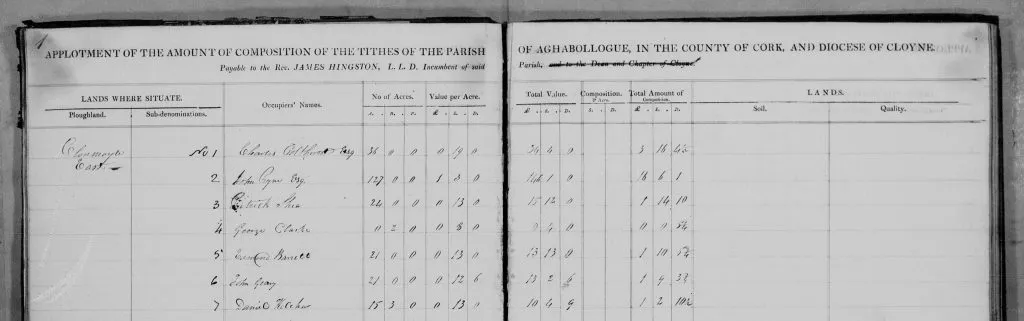
Tithe Applotment Books (1823 to 1837). One of the most important pre-Famine surveys to survive the 1922 destruction.
The records that survived are remarkably rich. The challenge is knowing which ones to use, and how to read what they contain.
Gary Skerritt, Meet Your Past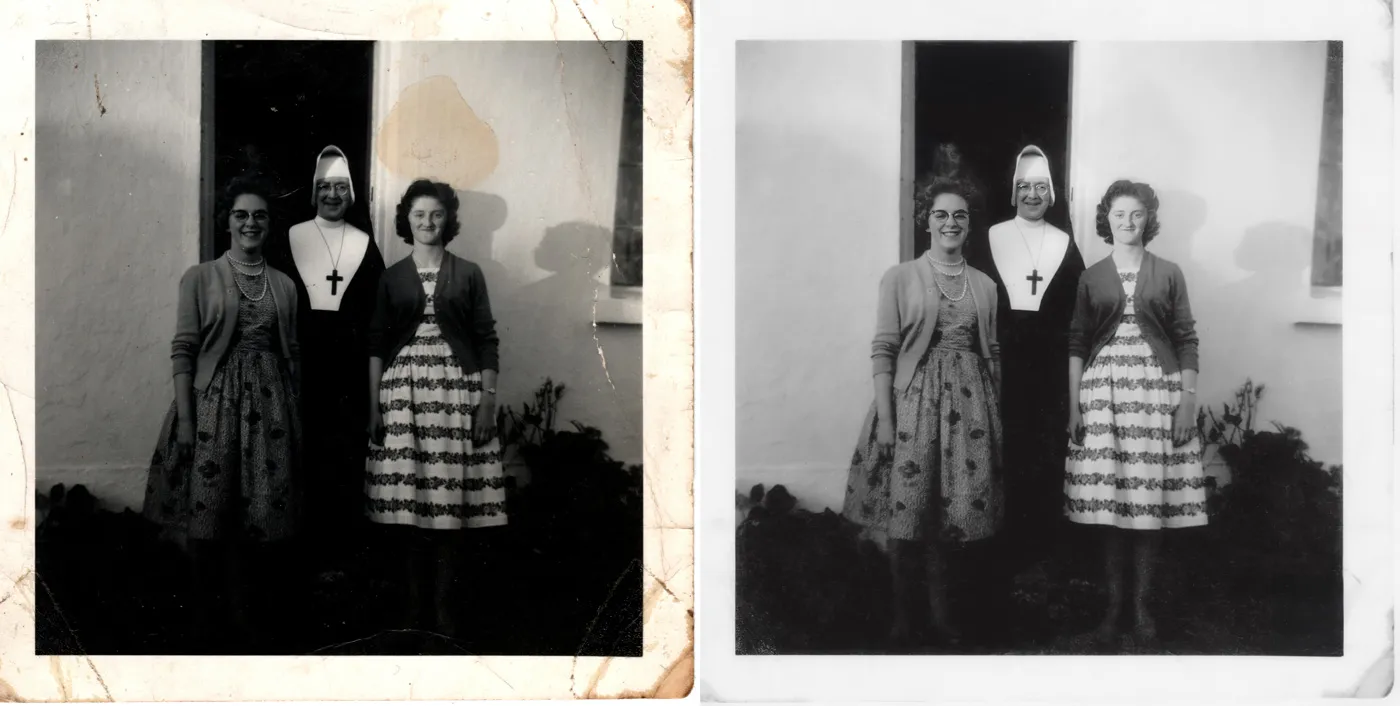
My father came from Ireland.
This is part of my own story.
I did not come to Irish genealogy through a textbook. I came to it through my own family. My father was Irish, and tracing that side of my history meant working through exactly the same record gaps that every client faces. The 1922 destruction, the missing civil registration, the Catholic parishes with no records before the 1820s. I know these obstacles from personal experience, not theory.
What that experience taught me is that the surviving Irish records reward a careful and methodical approach. Griffith's Valuation can place a family in a specific plot of land with a precision that few other countries could offer for the same period. The Tithe Applotment Books can anchor a line in a parish decades before civil registration began. Catholic parish registers, once found, can take a family back two centuries. DNA, used alongside the documentary record, can unlock lines that no surviving document can reach.
Knowing the county is the beginning, not the answer. What matters is finding the townland. Once you have the townland, Irish research changes completely.
I also know Irish research from the Liverpool side. My wife's family has Liverpool roots, and large parts of the Irish diaspora moved through Liverpool in the 1840s and 1850s. The Famine migration left traces in Liverpool parish registers, workhouse records, and port arrivals that can fill gaps in the Irish documentary record. I work across both archives as a matter of course.
Irish ancestry research is more complex than British genealogy. That is simply the nature of what survived. But the discoveries, when they come, are among the most vivid and moving in all family history work.
The records that did survive are extraordinary.
The 1922 destruction was catastrophic, but it was not total. A substantial body of Irish genealogical material remains, spread across archives in Dublin, Belfast, London, and online. Knowing which records exist for a specific family, county, and period is the foundation of every Irish investigation I carry out.
Griffith's Valuation
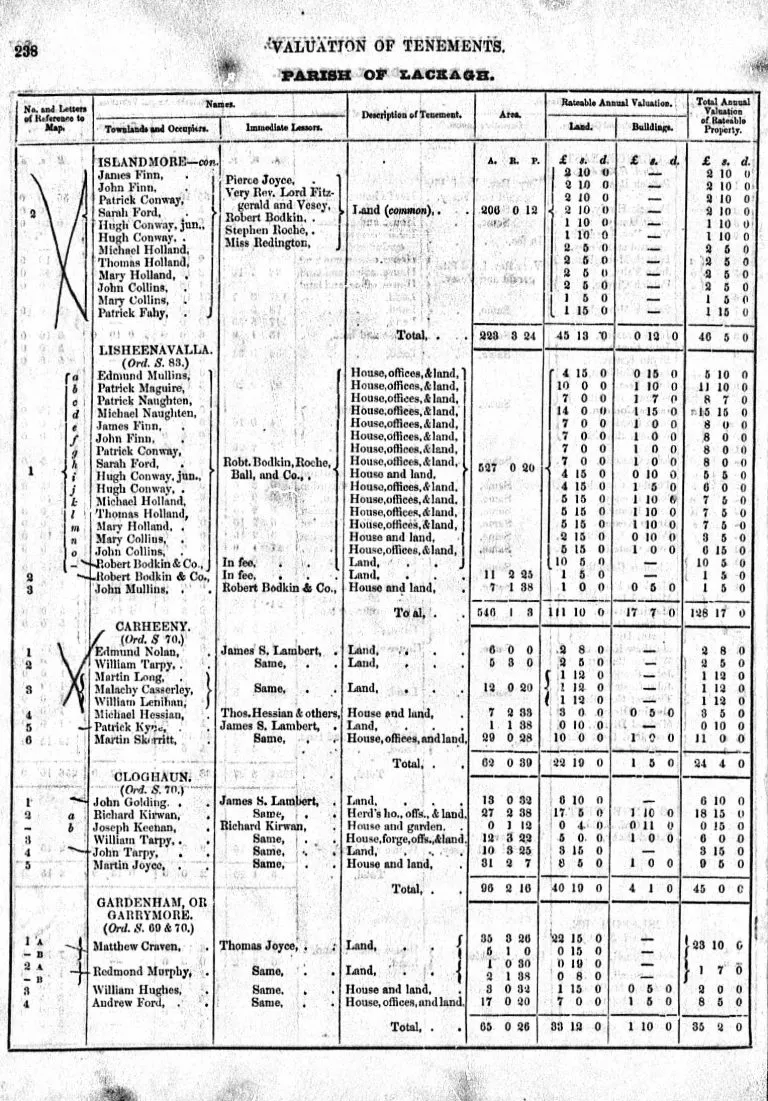
The most powerful surviving substitute for the lost mid-19th century censuses. Lists every occupier of land or property in Ireland, tied to specific plot numbers on detailed maps. It can place your ancestor in a precise townland, show the land they worked, and identify the neighbours who may have been relatives.
Tithe Applotment Books
An earlier pre-Famine land survey, particularly valuable in areas where Church of Ireland records survived more fully. Can anchor a family in a parish decades before civil registration began. Especially useful for establishing who was living where in the years before the Famine.
Catholic Parish Registers
Now freely available through irishgenealogy.ie and the National Library. The strategy is to search the whole parish, not just the one baptism you expect. Witnesses in Irish records were frequently grandparents, uncles, or siblings. Every name in a register is a potential breadcrumb.
Civil Registration
Civil registration began in 1845 for non-Catholic marriages and in 1864 for all births, marriages, and deaths. From this point the documentary record becomes more systematic, though gaps in registration still occur. These records form the backbone of any 19th-century Irish investigation.
Census Records
The 1901 and 1911 census returns for the whole of Ireland survived intact and are available free online. Earlier returns were destroyed, though fragments from 1821 to 1851 survive for some areas. The 1901 and 1911 records are among the richest genealogical documents in existence for Irish families.
PRONI and Revision Books
The Public Record Office of Northern Ireland holds exceptional resources for Ulster families, including Valuation Revision Books that trace landholding changes through the later 19th and early 20th centuries. Particularly important for families in counties Antrim, Down, Armagh, Fermanagh, Tyrone, and Londonderry.
Master the townland.
Everything else follows.
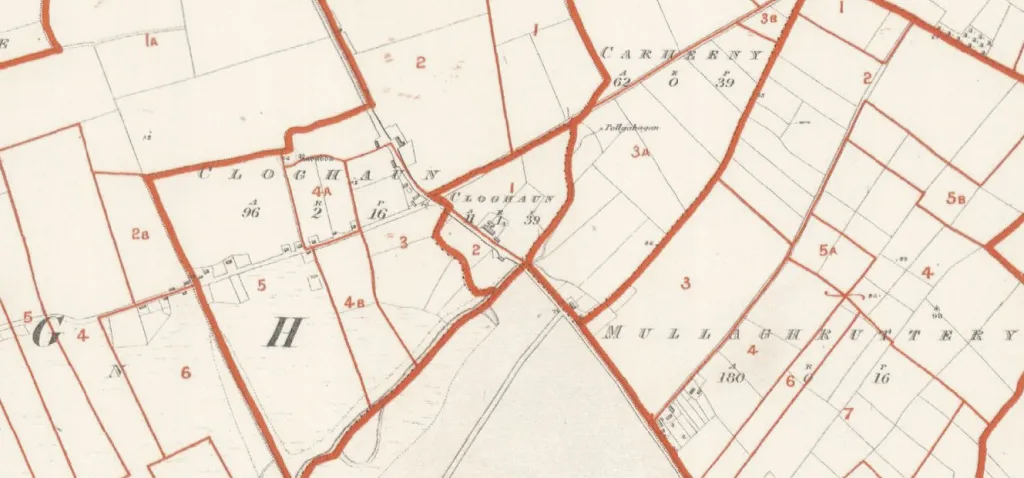
Townlands are Ireland's smallest land divisions. There are more than 62,000 of them, and nearly all surviving Irish genealogical records are organised by townland rather than by surname. A county tells you almost nothing. A townland changes everything.
If your great-grandmother's birthplace appears as Ballynagloch in one document, it may appear as Ballynaglogh, Ballynaglough, or simply Glough in another. Spelling variants are not errors. They are the normal state of 19th-century Irish record-keeping, and recognising them is part of the investigative process.
- More than 62,000 townlands across the island of Ireland
- A single county such as Galway contains approximately 4,474 townlands
- All surviving land surveys, valuation records, and most parish registers reference the townland, not the county
- Logainm.ie provides official place name spellings and Gaelic origins
- Many diaspora records include the townland when the birth certificate does not
Establishing the correct townland is usually the first task of an Irish investigation. Once it is confirmed, the documentary record opens considerably. Family letters, naturalisation certificates, ship manifests, and the backs of old photographs are often the most direct route to this single critical detail.
Irish naming patterns are a built-in family tree.
The Irish naming tradition was not just convention. It was a systematic way of preserving family identity across generations, and for a genealogist it acts as a quiet roadmap through the records.
The typical Irish naming pattern followed a consistent logic. The first son was named after the father's father. The second son after the mother's father. The first daughter after the mother's mother. The second daughter after the father's mother. Subsequent children were often named after aunts, uncles, or godparents.
This means that if your ancestor was the eldest son, born in 1865 and named Patrick, and his father was Michael, there is a strong probability that Michael's father was also Patrick. The pattern does not solve a line on its own, but it narrows possibilities dramatically when documentary evidence is sparse.
It also explains why you can find ten men named John O'Connor in the same parish within a decade of each other. They are not the same person. They are cousins and second cousins following the same naming system down separate branches of the same extended family.
Traditional Irish naming convention
Reading the pattern
- 1st son Father's father
- 2nd son Mother's father
- 3rd son Father himself
- 1st daughter Mother's mother
- 2nd daughter Father's mother
- 3rd daughter Mother herself
In practice, patterns were not always followed precisely, particularly after emigration or in the generations following the Famine. Treat them as a guide, not a rule.
DNA is often the only way past
the early 19th century.
For Irish research, DNA is not optional. Because so many documentary records were lost, DNA testing has become the primary tool for breaking through brick walls before the 1820s. Irish DNA clusters tend to be tight-knit and geographically localised. Even a modest match can point to a specific county, and in some cases a specific parish.
I integrate DNA evidence directly into documentary research rather than treating it as a separate exercise. A DNA match that points to a Galway family, combined with a Griffith's Valuation entry and a Catholic parish register, can connect dots that no single source could manage alone.
AncestryDNA carries the largest Irish database and is the most useful platform for Irish research by far. I can also work with results from other platforms and apply the same analytical approach to each.
Irish DNA clusters are among the most geographically specific in the British Isles. A match to a cluster rooted in County Clare does not simply tell you that a relative came from Ireland. It can narrow a search to a handful of parishes.
For families whose Irish documentary record was destroyed or never existed, DNA is not a supplementary tool. It is often the investigation itself.
I use chromosome mapping, shared match analysis, and cluster methodology alongside the standard documentary research approach. If you have results you cannot interpret, the free consultation call is a good place to start.
The Irish investigation process
Every Irish investigation follows the same structured approach, beginning with what you already know and working systematically through the surviving record layers.
Gather what you have
Family papers, letters, prayer cards, old photographs, naturalisation documents. The townland name is often hiding in a source you already own.
Establish the townland
Without the townland, Irish research stalls. Establishing the precise location is the first and most important task of any investigation.
Work the surviving records
Griffith's Valuation, Tithe Books, parish registers, civil registration, census returns, estate records. Each layer adds to the picture.
Integrate DNA where needed
Where documentary records are absent or ambiguous, DNA evidence is brought into the investigation to break through the remaining barriers.
The key websites for Irish genealogy research
These are the core online resources I use for every Irish investigation. Each covers a different portion of the surviving record base.
Questions about Irish ancestry research
These are the questions I am most frequently asked about Irish investigations.
Let us bring your
Irish ancestors home.
Irish genealogy is rarely straightforward, and the gaps in the archive are real. But the discoveries, when they come, are among the most vivid and moving in all of family history research. A surviving baptism entry in a County Mayo parish register, a townland name on a Griffith's map, a photograph that has waited a century to be placed in context.
If you have old Irish photographs that need restoring, that is a service I also offer. See the photo restoration page.
Book a free 30-minute call and I will talk through what you already know, which records are most likely to survive for your family's area, and what a realistic investigation might find. No preparation needed. No obligation.