Family History
Research Across
the East Midlands
Every family in this region has a story. Most of it is still waiting to be found.
Meet Your Past is based in Nottingham and provides fully done-for-you family history investigation across Nottinghamshire, Derbyshire, Leicestershire, Lincolnshire, and Rutland. Specialist in local archive records, Irish ancestry, DNA investigation, and military research. Home visits available throughout the region.
Free. No obligation. No sales pressure.
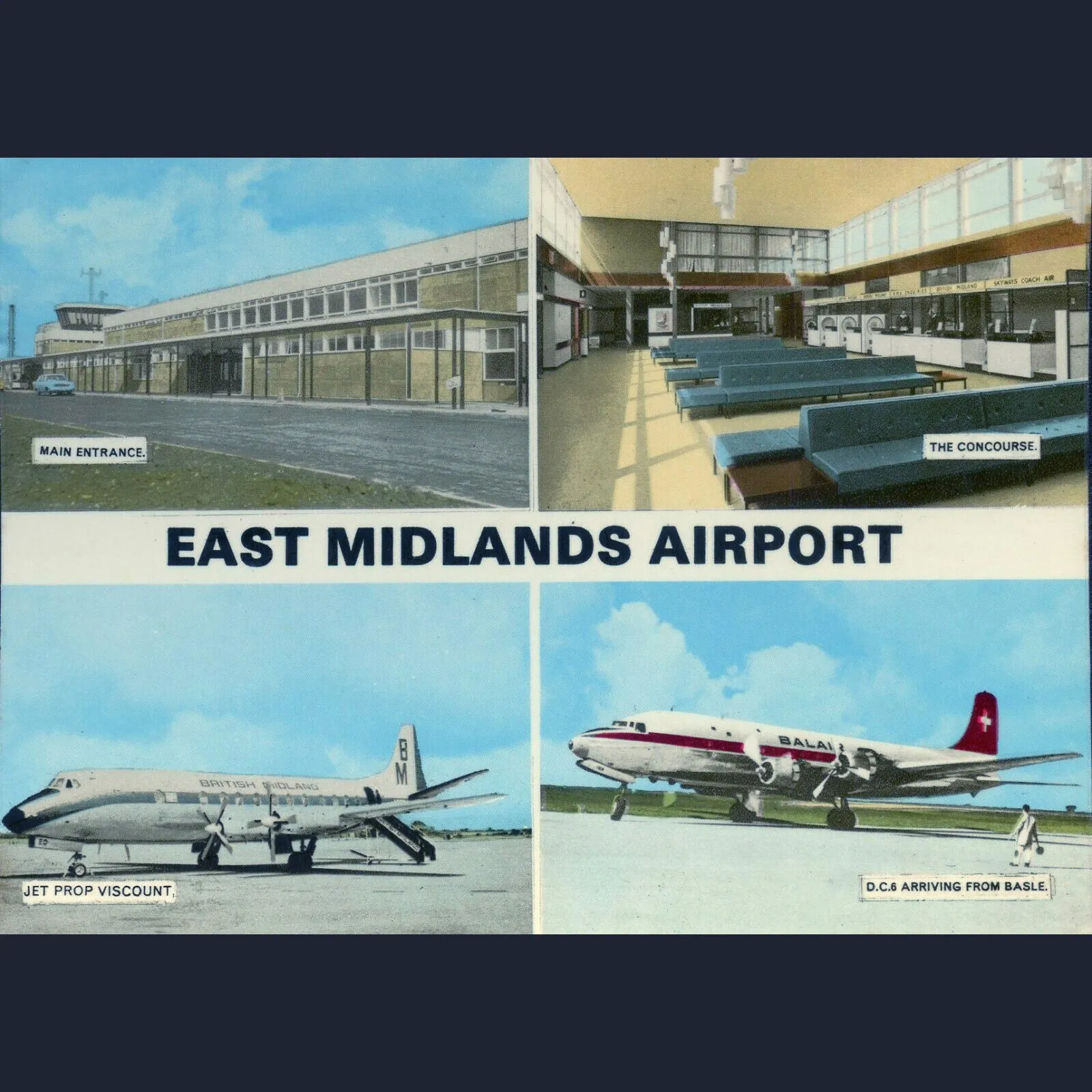
One of England's richest regions for family history.
The East Midlands does not have a single identity. It is a region of coal miners and lace makers, agricultural labourers and canal builders, Irish migrants and Dissenting chapel communities, framework knitters and railway navvies. Every one of those lives left records, and most of those records survive.
What is less well known is how much of the East Midlands story runs directly into Ireland. Tens of thousands of Irish families crossed in the nineteenth century to work the lace and hosiery trades in Nottingham, the coal seams in Derbyshire, and the railway lines threading through all five counties. Many of their descendants have never followed that thread back.
Meet Your Past is based in Nottingham and conducts investigations across the whole region. The research is fully done-for-you, delivered as a written narrative report with copies of every significant document found. Home visits are available throughout Nottinghamshire, Derbyshire, Leicestershire, and Lincolnshire.
Book a free 30-minute call to talk about your familyResearch and home visits across all five counties
Meet Your Past is based in Nottingham and serves clients across the full East Midlands region. Each county has its own archive, its own industrial heritage, and its own character. Select a county below to explore its particular record landscape and research history.
The home county for Meet Your Past. Gary has the deepest working knowledge of Nottinghamshire Archives, the city's Irish community, and the lace and hosiery industry records that document so many Nottingham families from the eighteenth century onwards. Nottinghamshire parish registers survive from 1538 at St Mary's, Nottingham.
Coal mining, the Derbyshire lead industry, and the textile mills of the Derwent Valley make Derbyshire one of the most industrially documented counties in England. Derbyshire Record Office in Matlock holds extensive parish registers, colliery records, and landed estate papers. Many Derbyshire mining communities also have strong Irish family connections.
Leicestershire has one of the best-resourced county archives in the Midlands, with material dating back to the sixteenth century. The hosiery and boot trades generated substantial employment records. Rural Leicestershire parishes are well documented in both Anglican and Nonconformist registers.
Lincolnshire holds one of the largest surviving collections of pre-1837 parish registers in England. Agricultural and fenland communities are well documented, and the county's RAF and naval heritage means significant military record holdings. Lincolnshire Archives in Lincoln is one of the most accessible county repositories in the region.
Research follows the evidence, not county boundaries. East Midlands families moved between counties constantly throughout their history. An investigation that starts in Nottinghamshire will frequently lead to Derbyshire or Lincolnshire. Many will eventually trace back to Ireland. The research goes wherever it needs to go, including across the UK and into Irish, military, and DNA records.
The records that tell East Midlands family stories
Much of the most useful material for East Midlands research is not available through online subscription services. Knowing which archives hold what, and how to access it, is a meaningful part of specialist local knowledge.
Civil Registration
GRO birth, marriage, and death certificates from 1837 onwards, including full paper certificates ordered direct from the GRO. The full certificate is often more informative than the online index entry alone, carrying additional family detail that the index omits.
Census Records
The 1841 to 1921 censuses provide a picture of every household in England and Wales at ten-year intervals. The 1921 census, released in 2022, carries particularly detailed occupational and birthplace information, often identifying Irish county of origin in a family for the first time.
Parish Registers
Anglican baptism, marriage, and burial registers for Nottinghamshire parishes survive from 1538. Nonconformist chapel records, particularly for Methodist, Baptist, and Congregationalist congregations, are extensive across all five East Midlands counties and document many families absent from Anglican sources.
Trade and Occupational Records
Lace and hosiery industry records, framework knitters guild documents, coal mining employment registers, Derbyshire lead industry archives, and Midlands railway company records. These are largely unavailable online and require direct archive access. They provide an extraordinary level of family and community detail.
Probate and Land Records
Wills, administrations, and property records from ecclesiastical courts and the Prerogative Court of Canterbury, alongside manorial records and land tax assessments. These can place a family in a specific parish and social context centuries before civil registration began in 1837.
DNA Investigation
Genetic genealogy used alongside documentary research to confirm family connections, break through brick walls, and identify previously unknown relatives. Particularly powerful for tracing Irish origins when documentary records are absent, and for investigations into unknown parentage.
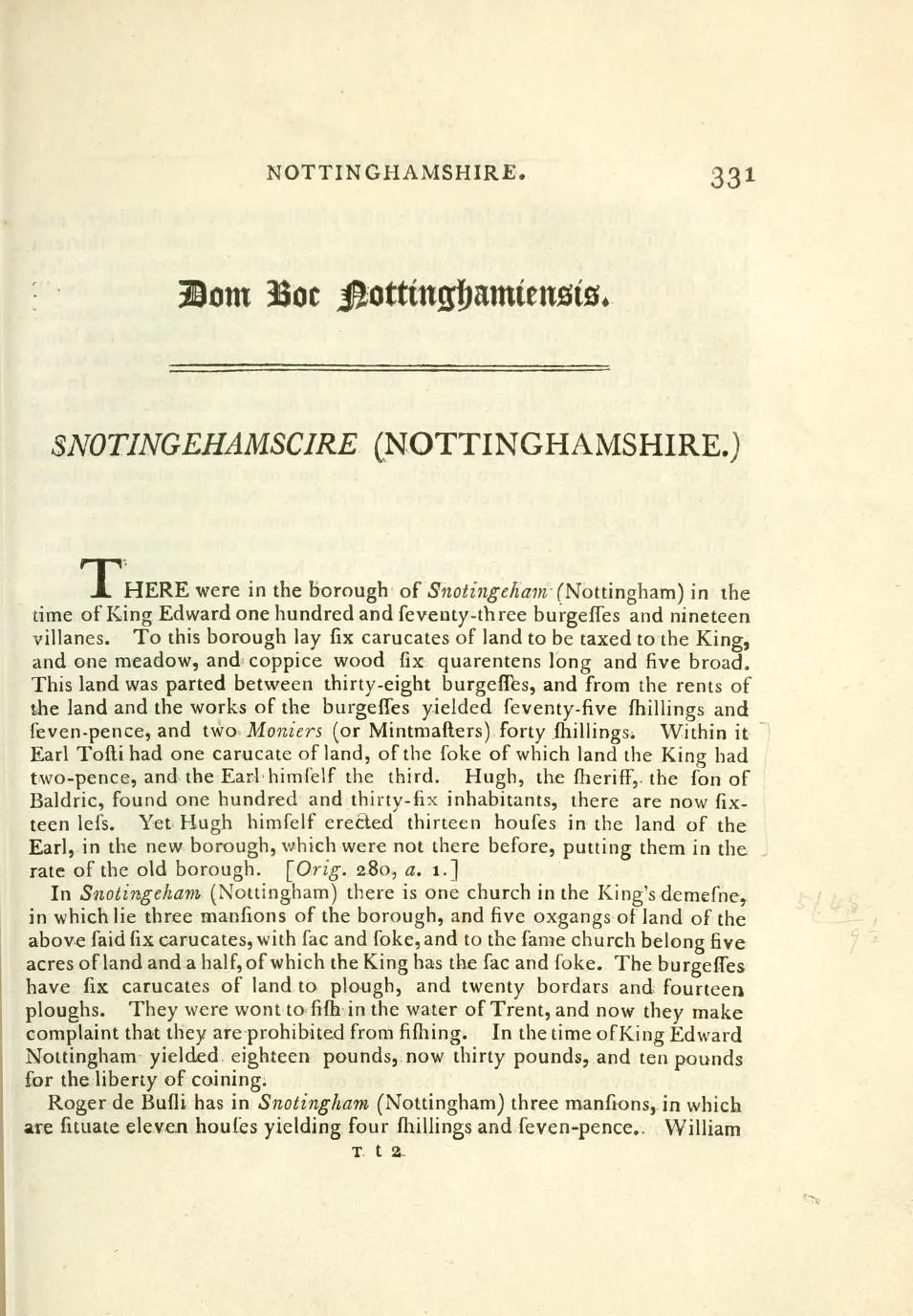
The Domesday entry for Snotingehamscire records the borough of Nottingham as it stood at the time of the Norman survey. It names burgesses, landholders, and the properties of Earl Tosti and Hugh the Sheriff. For East Midlands families, this is the earliest point at which the written record of the region begins. Parish registers would not appear for another four centuries. The survey demonstrates both how far back the documentary record reaches and how much of this material is held in archive collections rather than online databases.
There were in the borough of Snotingham, in the time of King Edward, one hundred and seventy-three burgesses and nineteen villanes. To this borough lay six carucates of land to be taxed to the King, and one meadow, and coppice wood, fix quarentens long and five broad. This land was parted between thirty-eight burgesses, and from the rents of the land and the works of the burgesses yielded seventy-five shillings and seven-pence, and two Moniers, or Mintmasters, forty shillings.
In Snotingham there is one church in the King's demesne, in which lie three mansions of the borough, and five oxgangs of land of the above said six carucates, with sac and soke, and to the same church belong five acres of land and a half, of which the King has the sac and soke. The burgesses have six carucates of land to plough, and twenty bordars and fourteen ploughs. In the time of King Edward, Nottingham yielded eighteen pounds, now thirty pounds, and ten pounds for the liberty of coining.
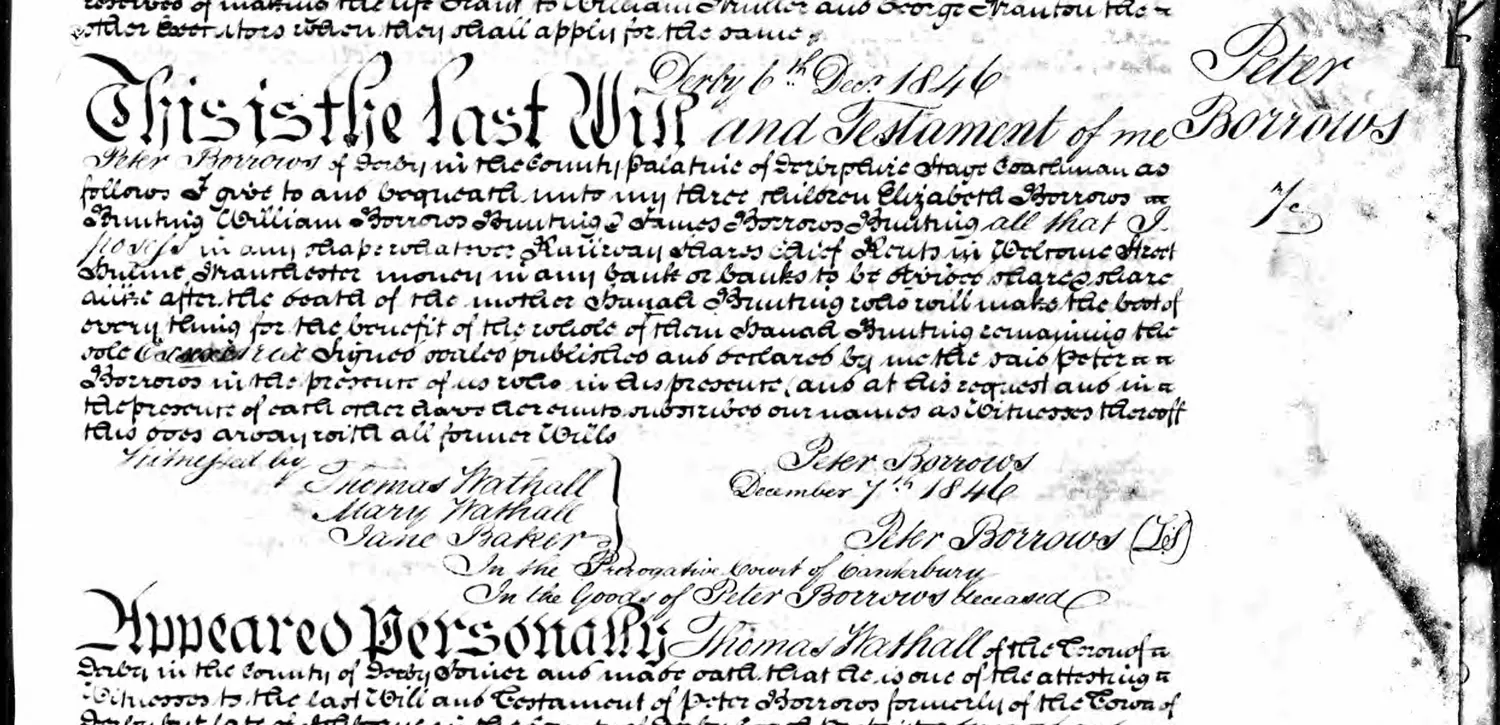
A will register entry from PROB 11 at The National Archives. The probate of Peter Borrows, Derby, granted 6 December 1846, is the kind of record that places a named individual precisely in time and location before the 1851 census. Probate records from this period frequently name beneficiaries, executors, and relationships not captured anywhere else, and many survive in good condition at both county record offices and at Kew.
Principal East Midlands archives. Nottinghamshire Archives (Castle Meadow Road, Nottingham), Derbyshire Record Office (Matlock), Leicestershire and Rutland Record Office (Leicester), and Lincolnshire Archives (Lincoln) are the four main county repositories. The Nottingham Local Studies Library holds a substantial collection of local newspapers, trade directories, and photographs not available elsewhere. Many important records are also held at The National Archives in Kew and are not accessible through online subscription services.
What an East Midlands investigation can involve
Each investigation is built around what the client already has and what they are hoping to find. The services below are the most common starting points for East Midlands research, though most investigations draw on several as the evidence develops.
Family History Research
A full investigation into one or more lines of your family, tracing ancestors through civil registration, census, parish, and archive records. Delivered as a written narrative report with copies of all key documents found. This is the core service for families with East Midlands roots.
Irish Ancestry Research
Investigation into Irish family origins using Griffith's Valuation, Tithe Applotment Books, surviving Catholic parish registers, and DNA. Gary has personal Irish heritage and detailed knowledge of what survived the 1922 destruction of Irish records, and what records can substitute for what was lost.
DNA Investigation
Interpretation and investigation using an existing DNA test result. Confirms or challenges documentary findings, identifies unknown relatives, and traces origins when written records run out. Particularly effective for East Midlands families with Irish roots that the documentary record has not yet reached.
Military Ancestor Research
Service records, medal rolls, pension files, and war diaries used to reconstruct a military ancestor's career. Covers both World Wars and earlier conflicts. Many East Midlands military men served with Nottinghamshire, Derbyshire, and Lincolnshire regiments whose records survive at Kew and specialist regimental archives.
Family History Gift
Family history investigation presented as a gift. A printed gift certificate is provided on purchase, ready to give on the day. Particularly meaningful for significant birthdays, retirements, and anniversaries. The investigation begins when the recipient is ready.
Unknown Parent Investigation
Investigation using DNA and documentary research to identify biological parents, grandparents, or other unknown relatives. Handled with care and full discretion throughout. Gary has personal experience of following DNA evidence through exactly this kind of investigation.
William Goddard: the ancestor hidden for four generations
Sentenced to hard labour in 1879. Quietly left out of the family story. Found, finally, through a DNA match and a trail through the Nottinghamshire Quarter Sessions records. This investigation is the foundation of Meet Your Past, and the reason Gary became a professional genealogist. It begins in Nottinghamshire and ends in a prison on Dartmoor.
A genealogist who knows
this region from the inside.
Meet Your Past was founded by Gary Skerritt, who is based in Nottingham. Gary has been investigating family histories for over 20 years, beginning with his own family and expanding into professional client work once the depth of what was achievable had become clear.
His father's side of the family is Irish. That means the experience of tracing lines through surviving Irish records is not theoretical. He has done it for his own family. He knows which archives hold what, how to work around the records destroyed in the Public Record Office fire of 1922, and what to do when the standard Irish sources run out. A significant number of East Midlands families have Irish roots, particularly those who arrived in the nineteenth century for the lace, hosiery, and mining industries. Where that applies, the Irish side of the investigation is informed by genuine personal knowledge.
His wife's family has roots in Liverpool, which has given him detailed working knowledge of Lancashire records and the Irish migration routes that brought families from the west coast ports inland to the Midlands across several generations. This Liverpool to East Midlands pathway is something no other regional genealogist can offer from lived research experience.
Gary has also spent 18 years photographing Nottinghamshire churches and parishes, giving him a physical familiarity with the landscape that shapes how the research is contextualised and presented. That knowledge rarely appears directly in a report, but it informs everything.
Read more about GaryFrom first call to final report
There are no hourly rates and no uncertainty about what the research will cost. Every investigation begins with a free conversation, and all work is quoted and agreed before anything starts.
Free consultation
A 30-minute call to discuss what you already have, what you would like to find, and whether professional research is the right step. No preparation needed. Bring whatever you have, even just a name.
Fixed-price quote
A clear written proposal setting out exactly what the research will cover and what it will cost. No hourly billing and no surprises. No work starts until you are satisfied with the proposal.
Investigation
Gary works through the archives and records relevant to your family, following the evidence wherever it leads. You receive updates as significant discoveries are made during the research.
Written report
A full written narrative of everything found, with copies of all significant documents discovered. Delivered digitally as standard, with a printed and bound version available on request.
Frequently asked questions
Meet Your Past covers the whole of the East Midlands, including Nottinghamshire, Derbyshire, Leicestershire, Lincolnshire, and Rutland. Home visits are available across all five counties. Research work can also be conducted for clients based anywhere in the UK and Ireland, regardless of location.
The principal archives are Nottinghamshire Archives, Derbyshire Record Office, Leicestershire and Rutland Record Office, and Lincolnshire Archives. Key record sets include GRO civil registration, Anglican parish registers, the 1841 to 1921 censuses, nonconformist chapel records, lace and hosiery industry documents, and probate archives. Many of the most useful records are not available online and require direct archive access.
Yes. A significant number of East Midlands families have Irish roots, particularly those who arrived in the nineteenth century for the textile, mining, and railway industries. Gary has personal Irish heritage and detailed knowledge of Irish genealogical records including Griffith's Valuation, the Tithe Applotment Books, and Catholic parish registers. DNA investigation is also available for families with unresolved Irish connections.
Yes. Home visits are available across the East Midlands. Many investigations benefit from beginning with a home visit, as it allows family documents, photographs, letters, and memorabilia to be reviewed together in person. This often reveals starting points and family knowledge that would never emerge from a remote consultation.
Fixed-price packages start from £199 for a single-surname investigation. All work is quoted in advance and there are no hourly rates or unexpected costs. You will know exactly what the research covers and what the price is before any work begins.
Not at all. Most investigations begin with very little. A grandparent's name, a county that was mentioned once, an old photograph with no names on the back. The free call is the right place to discuss what you have and what the research might realistically achieve from that starting point.
Tell me where you are,
and we will go from there.
Most investigations begin with almost nothing. A grandparent's name. A date that does not add up. A story that was never quite explained. That has always been enough to start.
Book a free 30-minute call and we will talk through what might be possible for your East Midlands family. No preparation needed. No obligation. Just a conversation about your family and what it might take to find their story.