1. The 1940 problem and what it means for WW1 research
On the night of 7 September 1940, the first major night-time bombing raid of the London Blitz caused catastrophic damage to the repository at Arnside Street, Walworth, where the bulk of the First World War Army service records were stored. The fires that followed destroyed approximately 60 per cent of all WW1 other ranks service records. These destroyed files are known collectively as the burnt documents.
This is the single most important fact in British military genealogy. If your ancestor served in the British Army in WW1, there is a roughly even chance that his service record no longer exists. For most families, this is the wall they meet when they start searching.
What this does not mean is that the research cannot proceed. The British military produced an extraordinary volume of documentation during WW1, and the service record was only one part of it. Medal records, pension files, unit war diaries, regimental histories, casualty records, and newspaper archives collectively provide a picture of a soldier's service that is often surprisingly complete, even when the original file is gone.
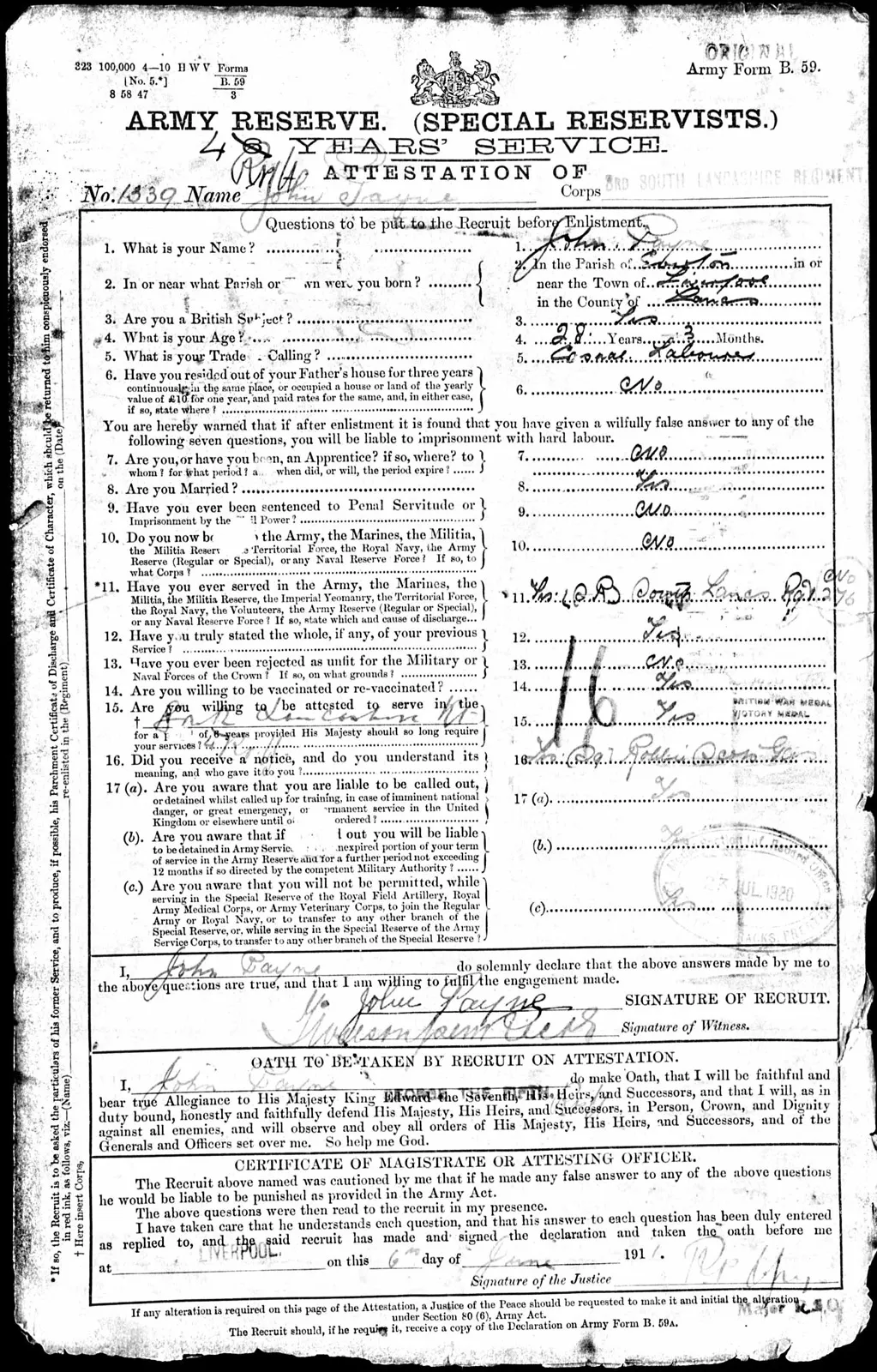
The records that did survive the 1940 fires are now held at The National Archives in Kew in the WO 363 and WO 364 series. WO 363 contains the records of soldiers who were discharged to pension, while WO 364 holds records of those discharged as medically unfit. Both series have been digitised and are searchable via Ancestry. If your ancestor's record survives, it will appear in one of these series.
For soldiers whose records were destroyed, the starting point is always the medal index cards in WO 372, which survive intact and cover every soldier who served in a theatre of war.
It is also worth understanding that officer records were held separately from other ranks, and the survival rate for officer records is significantly higher. If your ancestor held a commission, the search begins at The National Archives in the WO 339 and WO 374 series rather than the burnt documents collections.
2. WW1 records: what survives and where
Despite the losses of 1940, the volume of surviving WW1 material at The National Archives is substantial. Understanding which record series does which job is the key to making progress when the service record is absent.
Service Records (Surviving)
The surviving records of approximately 40 per cent of WW1 other ranks. Many are damaged or partially legible but contain attestation details, physical description, next of kin, service history, and cause of discharge. Digitised and searchable on Ancestry.
Medal Index Cards
A card for every soldier entitled to receive a WW1 campaign medal. Records name, number, rank, regiment, theatre of service, and medals entitled. Survived intact and is the most reliable starting point for any WW1 investigation where the service record is missing.
Pension Records
Pension files often contain medical boards, wound descriptions, service summaries, and family information. For many soldiers, the pension file is richer in detail than the service record would have been. The Ministry of Pensions records at PIN 26 complement and sometimes duplicate the WO 364 material.
Unit War Diaries
Daily records kept by every battalion, brigade, and division in the field. They record movements, operations, casualties, and orders. They rarely name individual soldiers below officer rank, but they establish exactly where a unit was on any given date and what it was doing. Essential for understanding what a soldier experienced.
Tracing a WW1 soldier when the service record is missing
The starting point is always the medal index card. This confirms that the soldier exists in the records, establishes his regiment, and indicates which theatres of war he served in. From the regiment and approximate dates of service, the relevant unit war diaries can be identified.
If the soldier was wounded, invalided, or discharged as medically unfit, pension records become the most detailed surviving source. The medical board papers within pension files frequently include physical descriptions, accounts of wounds, and notes on pre-war occupation that would otherwise appear only in the service record itself.
Casualty records, regimental publications, and local newspaper archives provide additional material. Local newspapers routinely published brief notices about men from their area who had been killed, wounded, taken prisoner, or decorated. These are now digitised in large numbers through the British Newspaper Archive and other platforms.
A note on the Silver War Badge registers. The Silver War Badge was issued to all servicemen discharged for wounds or sickness during WW1. The badge rolls record name, number, regiment, and reason for discharge. They survive at The National Archives in WO 329 and are a useful additional source for soldiers who left the army before the end of the war.
3. WW2 records: the Ministry of Defence process
WW2 Army service records have not yet been transferred to The National Archives. They are held by the Ministry of Defence Army Personnel Centre in Glasgow and are released only to the individual themselves, or, if deceased, to next of kin. The formal application process involves completing the MOD form and providing proof of relationship and proof of death.
The process typically takes several months, and often longer. This is not unusual and is not a sign that the request has been lost or refused. The MOD handles a very large volume of requests and works through them sequentially.
Applications are made to the Army Personnel Centre using the MOD's online subject access request system. You will need to provide the full name of the serviceman, approximate dates of service, and your proof of relationship. If the veteran is deceased, a death certificate is required. There is no fee for this application.
A professional researcher can manage this application on your behalf and will continue working through alternative sources while the official request is in process.
While the official record is awaited, research can continue through WW2 unit war diaries held at The National Archives in WO 166 and WO 169 series, operational record books for RAF service, medal rolls, the casualty registers held at The National Archives, and regimental histories published after the war. For men who served in campaigns abroad, campaign diaries and formation histories are often detailed enough to place a soldier's unit precisely and describe the conditions they served under.
RAF and Royal Navy service
Royal Air Force service records for personnel who served in WW2 are held by the RAF Personnel Management Agency and are released on similar terms to Army records. For aircrew, the Operational Record Books held at The National Archives in AIR 27 record every operational sortie flown by a squadron, with dates, targets, crew details, and outcomes. These are among the most detailed operational records available for any branch of service.
Royal Navy service records are held by the MOD Navy Personnel Archive. Ratings' records are released to next of kin, while officer records are frequently available through The National Archives in series ADM 196 for officers who left service before 1950. Ships' logs in ADM 53 are the naval equivalent of unit war diaries and place every vessel at its exact location on every date of service.
4. Medal records and what they reveal
Medals are often the most tangible piece of military heritage a family possesses, and they carry considerably more information than most people realise. Every WW1 campaign medal carries the soldier's name, number, and unit on its reverse rim. WW2 medals are typically unnamed, but the medal roll records the entitlement.
Campaign medals
Campaign medal rolls confirm which medals a soldier was entitled to receive. For WW1 they are held in WO 329 at The National Archives and largely duplicate the medal index card information. For WW2, the medal rolls are held in series WO 373 and equivalent series for the RAF and Royal Navy. These confirm service in particular theatres and help to establish approximate dates and locations of service.
Gallantry medals
The most significant record associated with a gallantry medal is the citation published in the London Gazette. Every Military Medal, Military Cross, Distinguished Conduct Medal, Distinguished Service Order, and Victoria Cross awarded during WW1 and WW2 generated a citation that was submitted to the London Gazette for publication. The citations describe, in varying levels of detail, the specific action or series of actions for which the award was made. They are freely searchable through the London Gazette website and are among the most vivid documents that military genealogy produces.
Below gallantry medal citations, the next most informative medal record is the Mentioned in Despatches register. Being mentioned in despatches was a recognition below the level of a formal award, and the records are sometimes overlooked. They appear in the London Gazette and confirm the approximate date and theatre of the commendation.
5. Before 1914: Victorian and earlier army records
For soldiers who served before the First World War, the research landscape is in some respects more straightforward. The records were not vulnerable to wartime bombing, and a substantial body of material is held at The National Archives in the WO series, covering service from the 18th century onwards.
Soldiers' Document (Attestation and Discharge)
The records of soldiers discharged to pension between 1760 and 1913. They record attestation details, physical description, service history, wounds, and reason for discharge. Coverage improves markedly from the mid-19th century onwards. Available on Findmypast and The National Archives.
Muster Rolls and Description Books
Muster rolls list every soldier present in a regiment at each periodic muster. Description books provide physical descriptions and enlistment details. Together they allow a soldier's service history to be reconstructed from enlistment to discharge, even when no individual service document exists.
Pension Records (Chelsea and Kilmainham)
The Royal Hospital Chelsea pension registers record pensions granted to invalid soldiers from the 17th century onwards. The corresponding Irish records are at Kilmainham Hospital. Both are valuable for tracing soldiers who received a pension on discharge, and the pension papers often contain biographical details found nowhere else.
Officer Records
Officers are generally better documented than other ranks throughout the Victorian period. The Army List records every officer's name, rank, and regiment on an annual basis. Service records and correspondence are held in WO 76 for earlier periods, with later officer records accessible through the Hart's Army Lists and the quarterly Army Lists available in many reference libraries.
The Boer War and other 19th-century conflicts
The South African War (1899 to 1902) generated its own distinct record series. Medal rolls survive in WO 100 and cover every soldier entitled to the Queen's South Africa Medal and the King's South Africa Medal, with clasps indicating the specific actions or campaigns in which the soldier served. These are among the most consistently indexed Victorian military records.
For the Crimean War (1853 to 1856), the Indian Mutiny (1857 to 1858), and the earlier campaigns of the 19th century, the relevant medal rolls and pension records follow the same archival logic, with the material distributed across the WO series according to the type of record. Regimental histories, often published privately in the late Victorian period, are invaluable for understanding what a unit experienced and where it served.
6. Record survival by conflict
The table below summarises what is available for each major conflict and where to find it. This is a practical starting-point guide rather than an exhaustive inventory.