Case Study · Personal Investigation · Nottingham · 1940

Grandad Wally
and the Stolen Motorcycle.

A wartime soldier, a Fox Hotel car park, and a motorcycle that vanished. Two Nottingham newspapers told the story I never knew existed.

My grandfather Walter Upton was a quiet man. He died before I was old enough to ask him questions. I knew he had a motorcycle from a photograph taken outside his house in Rockford Road. I had no idea that, in the summer of 1940, that very motorcycle ended up at the centre of a wartime court case at Nottingham Guildhall.

4 June 2026 Gary Skerritt, Meet Your Past Nottingham · St Annes-on-Sea · Horncastle
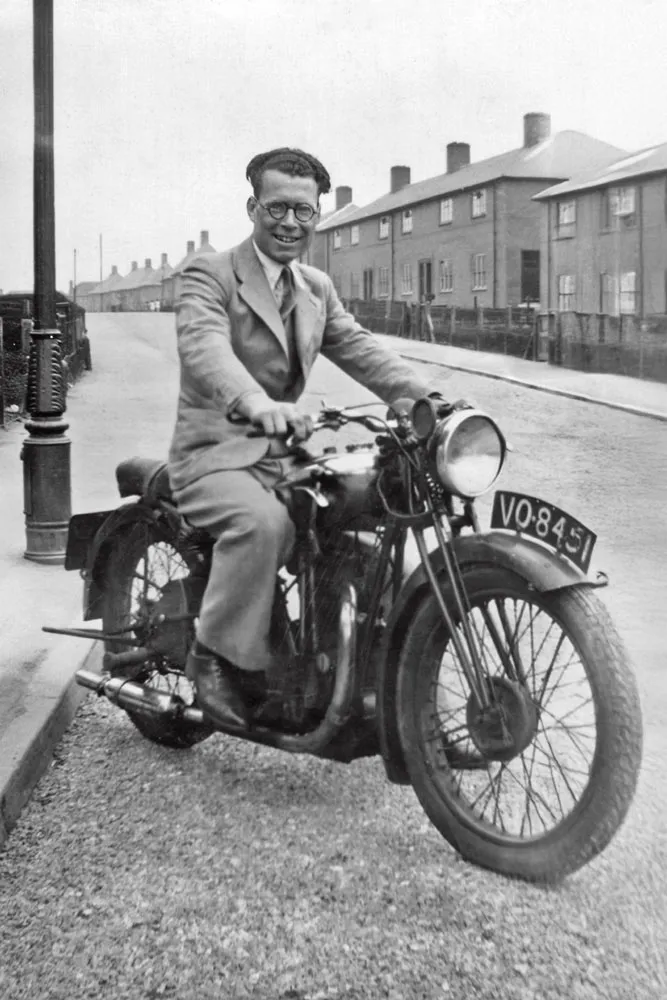
Walter Upton sitting astride his motorcycle, registration VO 8451, photographed on a street in Nottingham in the late 1930s.

Walter Upton on his motorcycle, registration VO 8451.
Photographed in Nottingham, late 1930s.

A photograph, a name, and a mystery

For most of my life I knew very little about my grandfather Walter Upton. He died before I was old enough to form a proper relationship with him, and the family had not thought to write much down. What I had was a photograph: a smiling man in a light suit, sitting astride a motorcycle on a Nottingham street, looking pleased with himself. He was the kind of person you feel you should have known.

The motorcycle became a research thread. The registration plate in the photograph, VO 8451, is visible in sharp detail. Registration VO placed the vehicle in Nottingham, and the number sequence placed its first registration in the late 1930s. I noted it and moved on.

Years later, searching digitised newspaper archives for Walter Upton in connection with other parts of his story, I found two reports that I was not expecting. On 22 and 23 July 1940, both the Nottingham Evening Post and the Nottingham Journal covered a case at Nottingham Guildhall involving a stolen motorcycle. The victim was named as Mr Walter Upton, of 12 Rockford Road, Nottingham. The motorcycle had been left in the car park of the Fox Hotel on Valley Road on the morning of 8 June 1940. It had been taken by a soldier.

The reports were eighty-six words long between them. But they told me more about my grandfather's life in the summer of 1940 than anything the family had passed down.

The context: June 1940

To read this story properly, you need to understand what June 1940 meant. The British Expeditionary Force had been withdrawn from Dunkirk at the end of May. Around 338,000 Allied soldiers were evacuated across the Channel in nine days. The men who came home were, by turns, traumatised, relieved, celebrated and confused. Britain was braced for invasion.

William Clarkson, the man who took my grandfather's motorcycle, was one of those returning soldiers. He was 28 years old, had been in the regular army since December 1931, and had served in France and Belgium with the BEF. His commanding officer, who appeared in court to speak in his favour, described him as reliable and very smart, and said that on two occasions in Belgium he had performed commendably. At Dunkirk he had been very good in taking wounded towards the boats.

On the morning of 8 June 1940, he came across a motorcycle in the car park of the Fox Hotel on Valley Road. My grandfather had left it there. Clarkson said later that he used to be a dispatch rider, and believed he could ride it. He had had a considerable amount of drink.

Summer 1940 in Nottingham
Dunkirk evacuations ended 4 June 1940. Clarkson had returned to England days before taking the motorcycle.
Returning BEF soldiers were often disoriented, drunk, or temporarily out of army supervision in the days after evacuation.
Motorcycles were working transport in 1940. For Walter Upton, this was not a leisure machine. Its loss would have been a genuine inconvenience.
The Fox Hotel, Valley Road, was a well-known Nottingham pub. A car park in 1940 would have been modest, probably a yard to the rear or side.

What happened to the motorcycle

After Clarkson took the machine, my grandfather noticed it was gone. He reported it missing. The police traced it to St Annes-on-Sea in Lancashire. Parts of it were missing. Clarkson was found at the police station in Horncastle on Saturday, 20 July 1940, where a detective travelled to see him.

Clarkson told police he had been given the cycle for sale by a cricketer, who had asked one pound for it. He was prepared to pay for anything that was missing, though he said he had not disposed of anything himself. The detective, having heard his account, presumably found it unconvincing.

At Nottingham Guildhall on 22 July 1940, Clarkson pleaded guilty to three offences: stealing a motor cycle worth twenty-five pounds, driving without a licence, and driving without an insurance policy. The court heard the character evidence from his officer and, taking his war record into account, applied the Probation Act to the theft charge. He was ordered to pay two pounds in damages and was disqualified from driving a private motor vehicle for twelve months.

My grandfather recovered his motorcycle, minus some parts, from St Annes-on-Sea. Whether it ever ran as well again is not recorded anywhere that I have found.

The newspaper reports: full transcriptions

Both reports are transcribed below in full, as published. The Evening Post reported on the day of the hearing. The Journal carried a more detailed account the following morning. Together they give a clear picture of the proceedings and the people involved.
The newspapers

Local newspapers in 1940 reported court proceedings in detail that would be unusual today. Names, addresses, and the full narrative of each case were printed as a matter of routine. It is precisely this habit that allows a stolen motorcycle to speak across eighty-six years.

Nottingham Evening Post
Monday, 22 July 1940 · Page 3
B.E.F. CORPORAL'S ESCAPADE
12 Months' Private Driving Ban

A smart-looking corporal who had distinguished himself in France and Belgium admitted three offences to-day at Nottingham Guildhall -- stealing a motor cycle worth £25, and driving the cycle without a licence and without an insurance policy.

Prisoner was William Clarkson, aged 23. The theft charge was dismissed under the Probation Act, and accused was ordered to pay £2 damages. He was also disqualified from driving a private motor vehicle for 12 months.

Det.-supt. Ellington explained that Mr Walter Upton, of Rockford-road, left his motor cycle in the car park of the Fox Hotel, Valley-road, on the morning of June 8th. Later he heard an engine "revving" and saw the accused across the saddle. He said to him, "You had better get off, or you will get hurt."

Clarkson said: "I used to be a despatch rider, and I can ride it." He got off the machine and went away with two other soldiers.

Later Mr Upton missed the cycle. The police traced it to St. Anne's, near Lytham. Parts of it were missing. Prisoner arrived at St. Anne's on June 10th and offered the cycle for sale. He said it had been given to him by a cricketer and he asked £1 for it. Det. Doubleday went to Horncastle on Saturday where he saw the prisoner at the police station.

Fine War Record.

Clarkson said he had been to France and Belgium. When he took the machine he had had a considerable amount of drink. He was prepared to pay for anything that was missing, though he had not disposed of anything.

Supt. Ellington said that there was no suggestion that prisoner had sold anything from the cycle, though £3 worth of damage and missing accessories were involved in the case. Prisoner had been in the regular Army since December, 1931.

An officer of the prisoner's regiment said that Clarkson was a reliable N.C.O., and very smart while in France. In action in Belgium he was very reliable. On two occasions he fought very commendable actions. One occasion was when he was on outpost duty as a section commander. Later, at Dunkirk, he was very good in taking wounded towards the boats.

"I would like to put these facts forward in his favour. At a time like this the Army needs N.C.O.'s of Clarkson's type," added the officer.

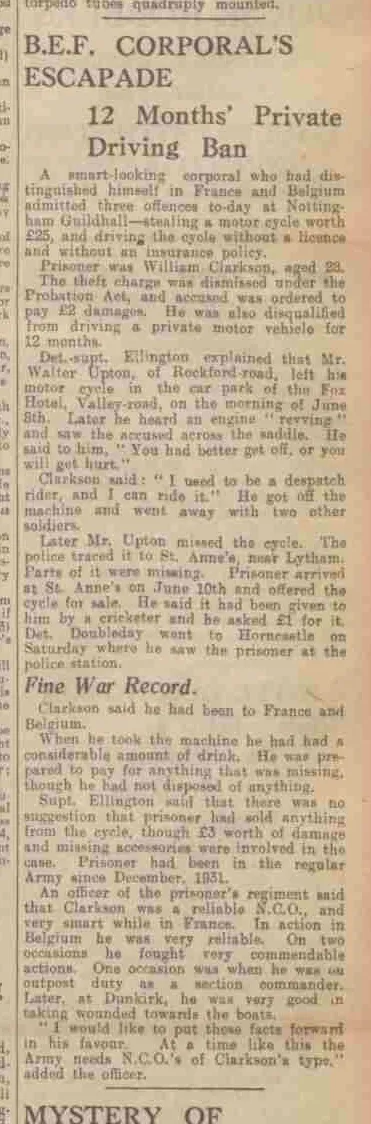
Nottingham Evening Post, 22 July 1940. Original newspaper cutting: BEF Corporal's Escapade, 12 Months Private Driving Ban. Walter Upton of Rockford Road is named as the victim.

Nottingham Evening Post, 22 July 1940

Nottingham Journal
Tuesday, 23 July 1940
Officer Puts In Good Word For Accused N.C.O.

A tall good-looking soldier, who was stated to have "fought very commendable actions," pleaded "Guilty" at Nottingham Guildhall yesterday to stealing a motor-cycle worth £25, and to driving it without a licence and without an insurance policy.

The charges were dismissed under the Probation Act and the accused, William Clarkson (28), was ordered to pay £2 damages.

He was also disqualified from driving a private motor vehicle for 12 months.

Dispatch Rider

Det.-Supt. Ellington stated that Mr Walter Upton, 12, Rockford-road, Nottingham, left his motor cycle in the car park of the Fox Hotel, Valley-road, on the morning of 8 June. Later he heard an engine "revving up" and saw the accused across the saddle.

He said to him: "You had better get off or you will get hurt."

Clarkson said: "I used to be a dispatch rider, and I can ride it." He got off the machine and went with two other soldiers.

Offered For Sale

Later, Mr Upton missed the cycle. The police traced it to St Annes-on-Sea and inquiries showed that Clarkson offered the machine for sale.

Parts of it were missing. A detective went to Horncastle on Saturday and saw the accused at the police station there.

Clarkson said that when he took the machine he had had a considerable amount of drink.

He was prepared to pay for anything that was missing, although he did not dispose of anything.

Very Smart N.C.O.

An officer stated that Clarkson was a reliable N.C.O. and very smart.

When they went into action in Belgium, he was very reliable, and on two occasions he fought very commendable actions.

At Dunkirk he was very good in taking wounded to the boats.

"At a time like this the Army needs N.C.O.s of Clarkson's type," added the officer.

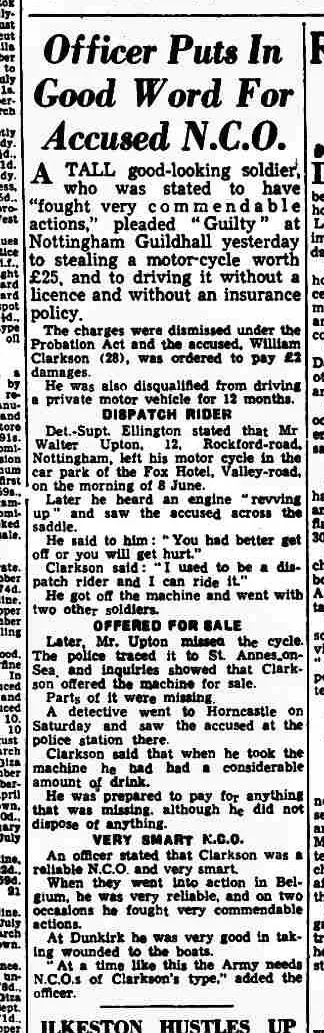
Nottingham Journal, 23 July 1940. Original newspaper cutting: Officer Puts In Good Word For Accused N.C.O. Walter Upton is named as the owner of the stolen motorcycle.

Nottingham Journal, 23 July 1940

What the records tell us about Grandad Wally

The two reports agree on the key facts. Walter Upton, of 12 Rockford Road, Nottingham, left his motorcycle in the Fox Hotel car park on the morning of 8 June 1940. He was present at the scene when Clarkson was sitting on it. He spoke to Clarkson directly, telling him to get off before he got hurt. He later reported the bike missing, and it was traced by police to St Annes-on-Sea.

A few things stand out. Walter was not a passive victim waiting at home. He was at the Fox Hotel that morning, present when the machine was being interfered with, and spoke to the soldier himself. He was observant enough to give police enough information to trace the cycle across the country.

The registration VO 8451 visible in the photograph confirms this was the same machine. VO was the Nottingham series and the number fits the late 1930s registration period. The motorcycle in the photograph is a real working vehicle, not a prop.

Every family photograph is part of a longer story. The challenge is finding the next document that continues it.

The soldier who took it

William Clarkson is treated sympathetically by both newspapers, and the court was lenient with him. He had been in the Army for nearly nine years, had fought in France and Belgium, had acted with commendable courage on two separate occasions, and had helped carry wounded soldiers to the boats at Dunkirk. He had come back from one of the most traumatic military events in British history and, within days, had taken a stranger's motorcycle while drunk.

The two pounds in damages was a token, and the driving ban was largely irrelevant to a serving soldier. The court applied the Probation Act, which did not leave a criminal conviction on record. His regiment wanted him back. The officer's final words, reported identically by both papers, are striking: at a time like this the Army needs N.C.O.s of Clarkson's type.

The hearing took place six weeks after Dunkirk. The context was everything.

What newspapers can do

This is a good example of why digitised newspaper archives matter so much to family history research. The two reports together gave me a precise date, a precise location, a street address, a named officer, a description of my grandfather as a witness, and the outcome of a court case. None of this appears in any civil record. It is not on a census. It is not on a birth, marriage or death certificate. It exists only in the newspaper.

For most families, the newspaper archive is largely unexplored. Court reports, announcements, letters, accidents, fires, local disputes, sporting achievements and wartime mentions are all in there, often indexed by name and fully searchable. A single afternoon searching your family names in digitised local papers can produce results that no other archive can match for narrative detail.

Walter Upton had a full life that I knew almost nothing about. A stolen motorcycle and two newspaper reports gave me one morning of it, in unusual clarity. This is what the archive can do.

I still do not know exactly where Walter was going that morning in June 1940, or why he left the motorcycle at the Fox Hotel rather than wherever he was headed. I do not know whether he was angry about the damage, philosophical about the outcome, or relieved simply to get the machine back. The newspapers tell me the facts. The rest requires imagination.

But the photograph no longer shows a stranger. It shows a man who parked his motorcycle in a pub car park one June morning and ended up in the local paper. That is more than I had before.

Stories like Walter's are everywhere in family records, waiting to be found. If you would like me to investigate your family's past, read about the family history research service.

The first step

There is a story in your family.
I can help you find it.

Book a free 30-minute call and I will show you exactly what we can discover with the names, photographs and fragments you already have. No preparation needed. Bring whatever you have, even just a name and a rough date.

The newspaper that named your grandfather might be sitting in a digitised archive right now, waiting to be searched.

Book Your Free 30-Minute Call

Free·No obligation·No sales pressure·Bring whatever you have, even just a name