

Received Seven Years in Prison for larceny. He Was My 2× Great-Grandfather.
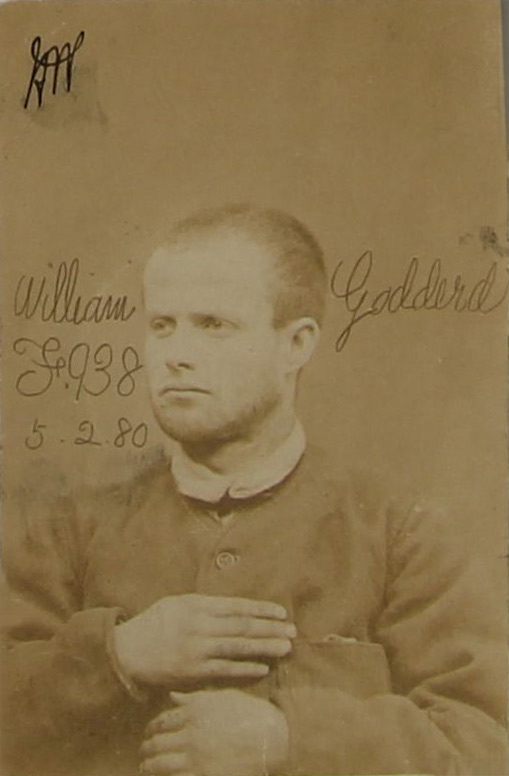
William Goddard, aged 25 – Millbank Prison, 5th February 1880
This Photo is 145 years old to the month (February 1880 – February 2025).
TNA ref PCOM 9/79 (Portraits of Convicts, 1879) photos were taken of any “habitual criminal” under the Prevention of Crimes Act 1871.
William’s multiple priors qualified him.
Sometimes the most shocking discoveries are the closest to home.
This is my 2× great-grandfather, William Goddard, my convict ancestor, photographed the day he arrived at Millbank Prison in London on the 5th February 1880. He had been sentenced to seven years’ penal servitude for stealing a jacket and what looked like the contents of a washing basket from Mrs Bearder.
What makes the story even stranger?
For years, my family and I had no idea that William Goddard even existed, it was a revelation that reshaped our understanding of our heritage. My mother was the bearer of her paternal surname “Upton” but in truth, my mum and her siblings should have been Goddard’s. My great-grandfather Walter (William’s son) was born illegitimate on the 19th July 1878, mere months before William’s trial. This is shown on his the birth certificate where his father’s name is left entirely blank. It was a blank space that echoed through generations, leaving us in the dark about his identity until persistent research finally brought the pieces together.

It took DNA matches and thousands of hours in the archives only to find in 1871, William had been living two doors away from my 2× great-grandmother Clara Upton afterall.
A childhood in the slums Born 12th August 1854 on Middle Street (now Middle Pavement), Nottingham, William grew up in the overcrowded courts and alleys of our Victorian lace town. His father was a lace-maker, his mother took in washing. By the age of 14 he was working as a whip-thong maker which were long, hard days pulling leather strips through metal dies for pennies.
The petty thefts started early:
- 10th February 1871 Stealing bacon (aged 17) – 1 calendar month hard labour
- 16th September 1871 Stealing braces – 1 month hard labour
- 12th June 1871 Stealing a pair of trousers, a pair of braces & 3 collars – 3 calendar months hard labour
- 24th February 1873 Stealing a Watch from a person – 6 months hard labour
- 30th October 1873 Absconding & public streets – Remanded & discharged
- 1st May 1874 Using Obscene language and Assault outside the Exchange – Fined 29shillings
- 9th February 1875 Stealing a hat – acquitted Lincoln
- April 1876 Larceny from person – 18 months hard labour Birmingham
- 21st January 1878 Stealing a pair of opera glasses – 3 calendar months hard labour
- 24th July 1878 Attempt to rob a satchel – 3 calendar months hard labour
The crime that changed everything for William was on the night of 30th June 1879. William and his his accomplice Ann Draper, broke into the home of Ann Bearder on Chaucer Street, near Market Street. They stole:
- A Lady’s Cloth Jacket
- Five chemises,
- Two pettycoats,
- Two night dresses,
- A sheet,
- Four pillow slips,
- Two bolster covers,
- Two skirts and
- A towel.
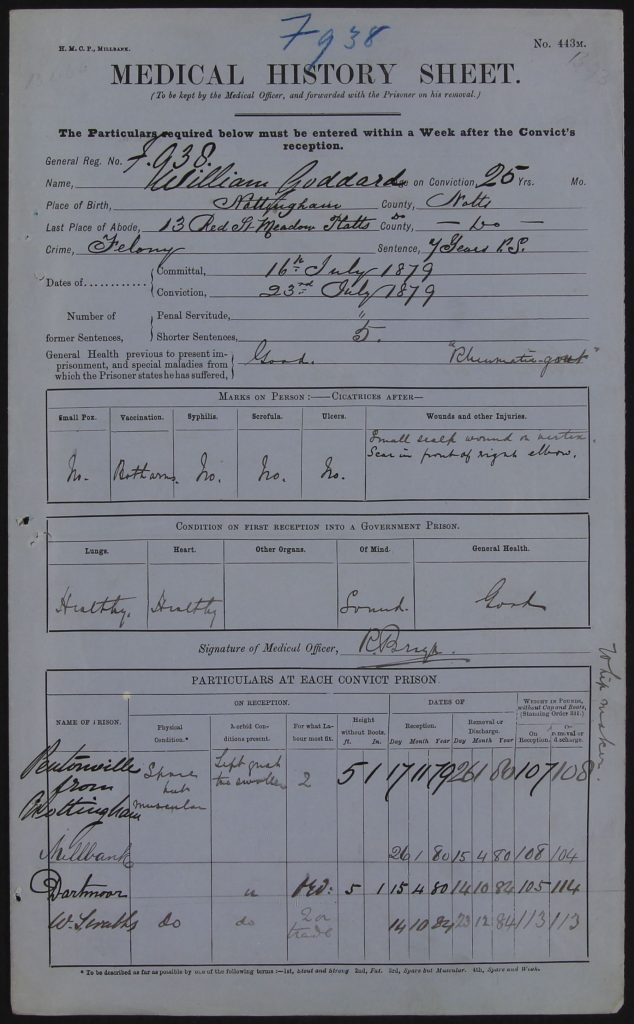
Medical History Sheet of my convict ancestor.
General Reg. No. F938
Name: William Goddard on Conviction 25 yrs.
Place of Birth: Nottingham County Notts
Last Place of Abode: 13 Red St Meadow Platts County Notts
Crime: Larceny Sentence 7 years
Dates of Committal: 16th July 1879
Conviction: 23rd July 1879
General Health: Rheumatism (at 25 years old this was probably caused from living in damp conditions)
Five years of hard labour. The sentence was brutal: Pentonville → Millbank → Dartmoor → Wormwood Scrubs. The prison file (HO 140/37, The National Archives) survives in full and makes grim reading:
- Severe inguinal hernia from breaking stone – issued a truss belt
- Chronic ulcers on both feet from wet boots
- Teeth described as “lost right side – bad set”
- Behaviour good, he only lost a few days’ remission for “Talking”(which wasn’t allowed in Victorian Prisons)
Teeth: “Lost right side – bad set”
This was the prison dentist’s shorthand way of saying his teeth were an absolute wreck, especially on the right side.
In 1879 convict prisons, dental descriptions were brutally simple. They only wrote anything if it was noticeably bad (most working-class men had rotten teeth anyway), so when they bothered to write a whole line like that, it meant it was strikingly awful.
What would William’s teeth have looked like in real life?
- Right side: Almost certainly missing most or all of the upper and lower molars and premolars on the right. Probably only jagged stumps left, or just black sockets.
- Left side & front: “Bad set” means the remaining teeth were heavily decayed, discoloured (brown/black), chipped, and loose. This is typical of someone who had never seen a dentist and lived on cheap tea with sugar, gin, and coarse bread.
Overall appearance at age 25:
He would have had a visibly sunken or lopsided cheek on that side when he smiled or talked. When he opened his mouth you would have seen a gappy, blackened ruin on his right, and a row of rotten, yellow-brown stumps on the left and front. He probably couldn’t chew properly on the right side at all which common among Portland/ Dartmoor convicts because the hard oakum picking and poor diet made existing decay far worse. Whip-thong makers also constantly chewed leather and wax-end thread so they wore teeth down fast.
So yes, “Lost right side of teeth – bad set” = truly shocking Victorian slum teeth. Most modern people would recoil if they saw it in person. He would have been noticeably disfigured by it for the rest of his life, and remember, he lived to 1924 which is another 45 years with that mouth.
His hernia very likely contributed to his early release. It was noted on his licence so the police could identify him if he re-offended (a man walking with the characteristic stiff-legged gait of a bad truss was easy to spot).
In plain modern language: William Goddard had developed this painful groin hernia from years of heavy lifting and prison labour, bad enough that by 1882–83 he could no longer do hard work and was wearing a truss for the rest of his life.
This section tells us a huge amount about how physically broken the prison system left William by his late 20s.
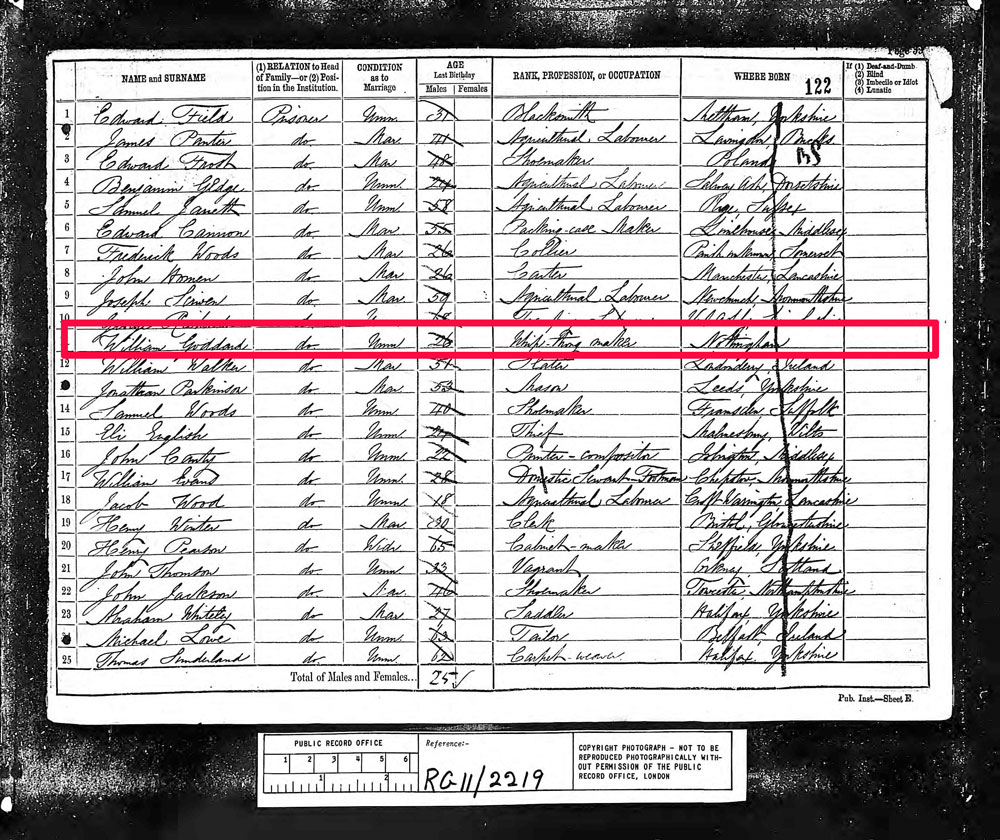
Census taken on Sunday April 3rd 1881 taken at Dartmoor Prison.
William was released on licence in December 1884, five years in, broken in health but with £13 gratuity (worth about £1,410 today).
Life after Prison.
William went back to Nottingham and worked as a labourer where he could. Unfortunately, William got himself into big trouble again in 1888 (another post to come). In 1911, he lived at 4 Kenton Square off Mortimer Street. My grandfather was born at 9 Kenton Square, the same year so were neighbours. William did have another son, a William born in 1886, who unfortunately died of gunshot wounds at Gallipoli in 1915. William himself died in 1924 in Bagthorpe Workhose on Hucknall Road, aged 69.
Finding William wasn’t easy. It took DNA, archive visits, prison registers, census returns, newspaper reports and a lot of late nights and many wrong turns. But when the pieces finally clicked, it felt like meeting a ghost who had been waiting for someone to tell his story properly. Without my convict ancestor my family and I wouldn’t have existed.
This is exactly what I do for my clients.
Could you have a convict ancestor? Most people who contact me only know their grandparents’ names. Some worry there’s “nothing interesting” in their tree. Others are nervous that there might be too much scandal.
I’ve seen it all, from bigamy, workhouses, soldiers, illegitimate children, desertions, and yes, the occasional convict. None of it changes the fact that these were real people doing their best (or sometimes their worst) in hard times.
If you’ve been putting off finding out, let’s have a chat.
Book a free 30-minute call, and I’ll show you exactly what we can discover with the names you already have.
Leave a Reply